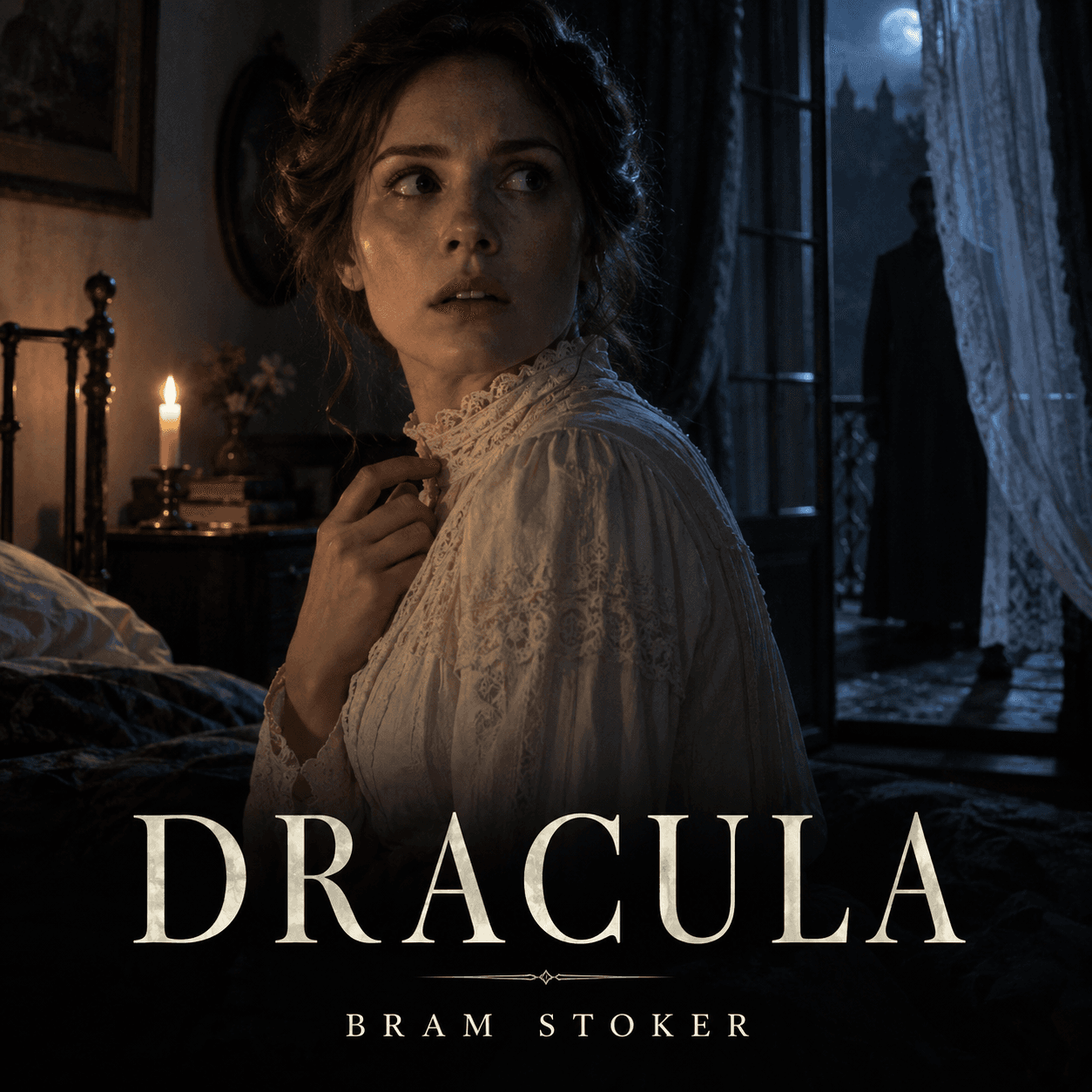
About this production
Dracula was published in London on 26 May 1897 by Archibald Constable and Company, and it is built unlike almost any other novel of its size. There is no narrator. The book is a dossier: Jonathan Harker's shorthand journal, Mina Murray's letters and typewritten diary, Dr. Seward's diary kept on a phonograph, Lucy Westenra's letters and her last terrified account, telegrams, a solicitor's correspondence about fifty boxes of earth, the log of a Russian schooner, two newspaper cuttings, and a memorandum by Professor Van Helsing written in the snow outside the castle. A short prefatory note explains that the papers have been placed in sequence and that "all needless matters have been eliminated". That structure is the reason this book casts the way it does.
The production reads every document in the voice of the person who wrote it. Harker's journal is Harker; the Whitby chapters are Mina's; the long middle of the book, kept on wax cylinders in an asylum at Purfleet, is Dr. Seward's, and his is the largest part in the production. Lucy reads her own letters, her own diary and the memorandum she leaves on the night her mother dies. Van Helsing, whose English is his own, speaks his lines and his memorandum. The log of the Demeter in Chapter 7 (39m 17s) is read by her captain, entry by entry, as the crew disappears one man at a time. The Pall Mall Gazette interview in Chapter 11 (31m 17s) about the wolf that escaped from the Zoological Gardens is played as a two-hander between the reporter and Thomas Bilder, the keeper, in his own idiom. Even the paperwork has voices: the Whitby solicitors, the carriers who moved the boxes, the two carters Harker tracks down in Chapter 20 (35m 32s), the agents at Mitchell, Sons & Candy, and the hospital sister in Buda-Pesth who writes to Mina. A separate editorial voice reads the preface. There are 44 speaking parts in all, and the listener never has to be told whose diary they have just entered. Our guide to what an AI narrator tells listeners is about exactly this problem, and how many character voices an audiobook needs puts a number on it for a book with this many documents.
The first four chapters are one man alone in a castle with his host, and they are the sample on this page. Chapter 1 (35m 31s) is the journey east: the landlady at the Golden Krone who asks "Must you go?" and presses a crucifix on him, the coach passengers crossing themselves, and the calèche at the Borgo Pass, where one of them whispers a line from Bürger's "Lenore", Denn die Todten reiten schnell, and the tall driver with the red lamplight in his eyes looks up and smiles. Chapter 2 (34m 18s) opens the door: "Welcome to my house! Enter freely and of your own will!" It has the Count's two most quoted lines, the wolves he calls "the children of the night" and the shaving glass he flings into the courtyard when Harker's mirror shows an empty room behind him. Chapter 3 (38m 33s) is the Count crawling face-down along the castle wall and the three women in the forbidden wing. Chapter 4 (35m 37s) ends with Harker on the precipice, writing what he believes is his last entry. For how a sequence like that is directed and mixed, see the horror and gothic production guide.
Then the book goes to England and the cast opens out. Chapter 5 (21m 32s), the shortest, is Lucy's three proposals in one day and the first entry of Seward's diary, with Renfield and his flies. Chapter 6 (34m 50s) is Whitby, the churchyard above the harbour and old Mr. Swales, who does not believe a word on the gravestones. Chapter 7 is the storm and the Demeter running aground with a dead man lashed to her wheel. From Chapter 8 (38m 29s) to Chapter 16 (31m 11s) the production is Lucy's long dying and what comes after: the transfusions in Chapter 10 (38m 51s), the wolf through the window in Chapter 11, her death in Chapter 12 (43m 46s), the "bloofer lady" of the Westminster Gazette in Chapter 13 (41m 19s), the empty coffin in Chapter 15 (36m 37s) and the tomb in Chapter 16. Chapter 17 (33m 58s) is the moment the papers themselves become the plot: Mina types up every journal into one chronological record, and the hunters read the book the listener has just heard. Chapter 18 (42m 53s) is Renfield's lucid plea to be released and the council of war. Chapter 21 (38m 20s) is the night in the Harkers' room, and Chapter 22 (32m 08s) the wafer and the scar. Chapters 23 to 27 are the chase, by sea, by train, by steam launch and on horseback, with the party split three ways across the Carpathians; Chapter 27 (47m 20s), the longest in the production, is the castle, the Szgany on the mountain road, and the sunset. The Note (2m 17s) is Harker, seven years later. We leave the rest alone.
The score and the sound design have a long way to travel: a diligence in the Carpathians, a castle with no servants, a harbour town in a gale, an asylum with a lunatic in the next room and a chapel next door, Hampstead Heath at night, a steam launch on the Sereth, and a mountain pass at dusk with snow coming. Most of it is heard through one person's account at a time, so the mix follows the diarist: Harker hears wolves and the door that will not open; Seward hears Renfield; Mina hears the sea. Audiobook sound effects: levels and mixing is about keeping a production like this legible, and does your book need a full cast? makes the general case. A novel written as a stack of first-person documents makes the specific one.
This is the complete text, not an adaptation: the preface, all 27 chapters and the closing note, in the order Stoker set them, with opening and end credits. Audible released its own Dracula on October 1, an adaptation by Robyn Ahern running about six hours with a cast led by Jonathan Bailey; we wrote about the features it launched with last week. The two editions are different things, and this one is the whole book. Its nearest companion in our catalogue is Frankenstein, the other gothic novel told through nested letters, and Jane Eyre is the other long first-person narration we have produced in full.
The production runs 16h 45m and is free to listen to. Bram Stoker died in 1912, and the 1897 text is in the public domain everywhere, so this title is available in every territory.
By the numbers
- Format: Full-cast dramatized audiobook, unabridged
- Chapters: 31 (the preface, all 27 chapters and the closing note, plus opening and end credits)
- Runtime: 16h 45m
- Cast: Count Dracula, Jonathan Harker, Mina Harker, Dr. Seward, Lucy Westenra, Van Helsing, Renfield, Arthur Holmwood, Quincey Morris, and 44 speaking parts in all
- Production: AI character voices, original music, and sound effects
- Price: Free to listen
Ready to try it on your own book?
Start your first chapter free →FAQ
Is this audiobook AI-narrated?
Yes. Every voice in Dracula is AI-generated and produced by Midsummerr, with an original score and sound design. AI narration is disclosed as such on retail platforms that require it.
How long is the audiobook?
About 16h 45m across 31 chapters: the preface, the novel's 27 chapters and the closing note, plus opening and end credits.
Who narrates it?
Nobody, in the usual sense. Dracula is written as a collection of journals, letters, diaries, telegrams, a ship's log and newspaper cuttings, and the production reads each document in the voice of the character who wrote it. Jonathan Harker reads his journal, Mina her letters and diary, Dr. Seward his phonograph diary, Lucy her letters, Van Helsing his memorandum, and the captain of the Demeter his log. A separate editorial voice reads the preface. There are 44 speaking parts.
Is this the full novel or an adaptation?
The full novel. The production follows the complete 1897 text in order, from the prefatory note to Jonathan Harker's closing note written seven years later.
Is Dracula in the public domain?
Yes. Dracula was published in 1897 and Bram Stoker died in 1912, so the text is in the public domain worldwide. The full text is on Project Gutenberg.
Where can I listen?
Listen free at midsummerr.com/listen/dracula-bram-stoker.