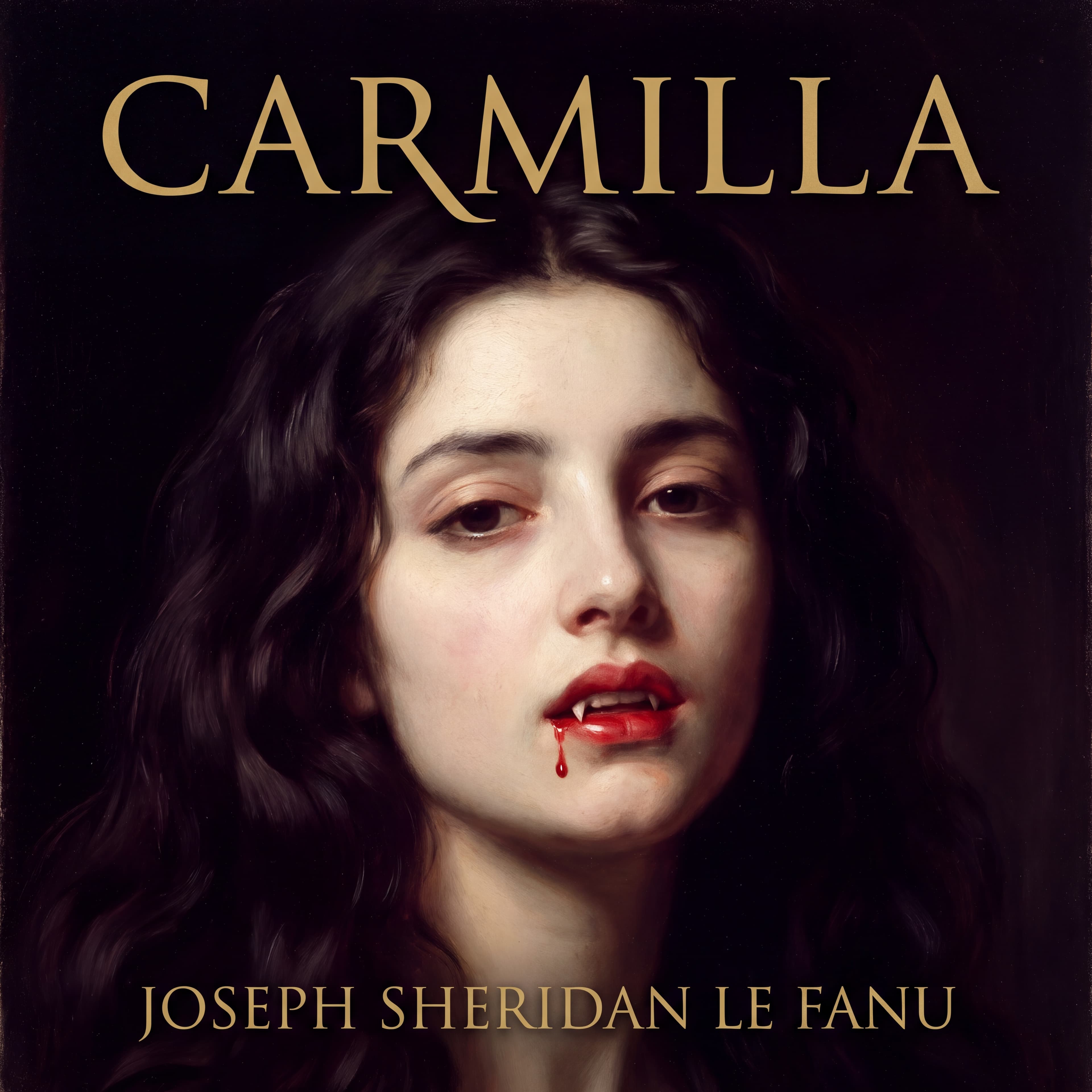
About this production
Carmilla came first. Joseph Sheridan Le Fanu's novella ran as a serial in the literary magazine The Dark Blue in late 1871 and early 1872, with illustrations by D. H. Friston and Michael Fitzgerald, and appeared the same year in his collection In a Glass Darkly, a quarter of a century before Dracula. It is told by Laura, who bears an English name but has never seen England, and lives with her widowed English father in a lonely schloss in the forests of Styria. A carriage overturns at their gate, a mysterious lady drives on and leaves her daughter in their care, and the guest turns out to have the face Laura saw at her bedside when she was six. Carmilla is beautiful, languid, secretive and intensely fond of her. A plague of wasting deaths moves through the villages, a restored portrait from 1698 shows Carmilla's likeness under another name, and Laura begins to dream of a black beast at the foot of her bed. Then General Spielsdorf arrives with the story of how his ward died, and the two stories turn out to be one. Le Fanu frames it all as a case from the papers of his fictional occult doctor, Martin Hesselius, published "simply to interest the 'laity'" by an editor who regrets to find that the lady who wrote it has since died. It is a story told by three people, and it needs a cast.
This production has 17 speaking parts, each on its own voice, and no voice is shared. Laura narrates and speaks her own part in the scenes, and her voice reads every chapter heading. A separate voice reads the editor's prologue. Carmilla has 88 lines across seven chapters, Laura's father 81 across eleven, and General Spielsdorf 133 across seven. The General is heard before he is seen. In Chapter II, Laura's father hands her the General's letter, and it is read in the General's own voice, from "I have lost my darling daughter, for as such I loved her" to "Farewell. Pray for me, dear friend." When he finally rides up in Chapter X and tells his story on the drive to Karnstein, the production gives it to him rather than to Laura: Chapters XI and XII carry 64 of his lines against three of her narration, as he describes the masked fête where a mysterious lady left her daughter, Millarca, in his care. Around them are Madame Perrodon and Mademoiselle De Lafontaine, the two governesses; the doctor who finds a small blue spot below Laura's collar; the hunchback mountebank with a salamander and a mandrake in his boxes, who sells Carmilla a charm; the woodman at the ruins; and Baron Vordenburg, who closes the book. How many character voices an audiobook needs explains why parts this size still get a voice of their own.
The score is built on three themes. One belongs to Carmilla. It enters in Chapter I, as six-year-old Laura sees "a solemn, but very pretty face looking at me from the side of the bed", returns in Chapter III when Laura recognizes that face on her guest, and follows Millarca through the General's story to the chapel in Chapter XIV, ten chapters in all. A second belongs to the Karnstein bloodline. It is first heard on the ruined village three miles west of the schloss, then under the General's vow to accomplish "a pious sacrilege", his bitter "And this was once the palatial residence of the Karnsteins!", the moment he names "Mircalla, Countess Karnstein", and Baron Vordenburg's account in the last chapter. The third is Laura's unease, which runs through nine chapters to the last paragraph. A sudden cue marks five revelations: the cleaned portrait ("It was the likeness of Carmilla!"), the two needles at Laura's breast in Chapter VI, Carmilla at the foot of Laura's bed in a white nightdress bathed in blood, the General's naming of her, and the stake. The General's masked ball has music of its own, the doctor's casebook opens the prologue and returns when the doctor examines Laura in Chapter IX, and the Karnstein ruins have an ambience of their own from Chapter XIII. The sound design stays with the text, with 95 effects placed to the word and 68 reactions in the characters' own voices. In Chapter II the carriage's horses bolt at the top of the steep bridge, a woman screams inside it, and it overturns as Laura covers her eyes. In Chapter IV a funeral hymn passes under the trees, and Carmilla complains of "strangling people with hymns", and later the mountebank scrapes his fiddle in the courtyard while his dog, which refused to cross the drawbridge, howls outside. In Chapter VI the "sooty-black animal that resembled a monstrous cat" paces the length of the hearthrug and springs onto the bed. In Chapter VII the household pounds on Carmilla's locked door, rings for the servants, and finds the room empty. The General hears "the axe of a woodman" at Karnstein, his boot stamp echoes through the ruin, and in Chapter XIV he catches up the woodman's hatchet and the blade falls to the floor as Carmilla dives under his blow. Our guide to producing horror and gothic audiobooks covers how much of that a scene can carry before dread turns into noise.
This is the complete novella, not an adaptation: the prologue and all 16 chapters in order, from "An Early Fright" to "Conclusion", with opening and end credits, and no line of the text left out. The chapters run from 7m 05s ("Bereaved") to 24m 31s ("Her Habits—A Saunter"), 3h 12m in all. The last line is Laura's: years later, she says, she still starts from a reverie, "fancying I heard the light step of Carmilla at the drawing room door", and the production lets you hear it. If you have heard our Dracula, this is the book that came before it. Joseph Sheridan Le Fanu died in Dublin in 1873. Carmilla is in the public domain in the United States, the UK and the EU.
Every line, cue and effect in this production sits on a studio timeline, the same one an author gets for their own book. Upload a manuscript and Midsummerr casts, scores and mixes it in one click. Then Martin, our AI audio director, takes notes in plain words. If you want Carmilla to sigh before she answers or the General to groan over his letter, you say so, and Martin adds the reaction in the character's own voice without producing the chapter again. Midsummerr is the only audiobook platform with an AI audio director.
By the numbers
- Format: Full-cast dramatized audiobook, complete text
- Chapters: 19 (the editor's prologue and Le Fanu's 16 chapters, plus opening and end credits)
- Runtime: 3h 12m
- Cast: Laura (narrator), Carmilla, Laura's father, General Spielsdorf (narrator of his own story), Madame Perrodon, Mademoiselle De Lafontaine, the mountebank, the woodman, Baron Vordenburg, and 17 speaking parts in all
- Production: AI character voices, original music, and sound effects
- Price: Free to listen
Ready to try it on your own book?
Start with 5,000words free →FAQ
Is this audiobook AI-narrated?
Yes. Every voice in Carmilla is AI-generated and produced by Midsummerr, with an original score and sound design. AI narration is disclosed as such on retail platforms that require it.
How long is the audiobook?
About 3h 12m across 19 chapters: the prologue and Le Fanu's 16 chapters, plus opening and end credits. The chapters run from 7m 05s (Chapter X, "Bereaved") to 24m 31s (Chapter IV, "Her Habits—A Saunter").
Who narrates it?
Laura, as in the book. The same voice tells the story and speaks Laura's lines in the scenes. General Spielsdorf reads his own letter in Chapter II and tells his own story, which fills most of Chapters XI to XIV. The editor's prologue has a voice of its own, and every other character has a voice of their own too.
Is it suitable for children?
No. It is a Victorian vampire story written for adults: young women sicken and die, Laura is bitten in her sleep, and the ending includes a staking and a beheading. The bond between Laura and Carmilla is also intense and romantic. The production keeps all of it, as the text does.
Is this the full book or an adaptation?
The full book. The production follows the complete text in order, with Laura narrating, the General telling his own story, and a separate voice for every speaking character. No line of the text is left out.
Where can I listen?
Listen free at midsummerr.com/listen/carmilla-joseph-sheridan-le-fanu.