About this production
Thomas Egerton published Pride and Prejudice in three volumes on 28 January 1813, and almost everything that happens in it happens in conversation. Mr. and Mrs. Bennet argue about a new neighbour in the first chapter. Elizabeth is slighted at a dance, refuses two proposals and is handed a letter that changes her mind, and then has to defend herself in a garden against a woman who has travelled nearly fifty miles to stop a marriage. A novel built on that much talk needs a cast more than it needs a single reader.
This production has 30 speaking parts: the narrator, George Saintsbury reading his own 1894 preface, and 28 characters. Elizabeth Bennet speaks in 50 of the 61 chapters and has 573 lines. Mrs. Bennet comes next with 214, a few more than Mr. Darcy's 207, then Jane (168), Mr. Bennet (148) and Mr. Collins (105). Lady Catherine de Bourgh appears in only four chapters but has 64 lines. Thirty-four of them come in Chapter 56, when she arrives at Longbourn to forbid an engagement that does not yet exist, and Elizabeth answers her with 31. In Chapter 35 (17m 03s), Darcy's letter is read in Darcy's own voice. Mrs. Reynolds, the housekeeper who shows the visitors round Pemberley, has 19 lines in a single chapter, among them that she has never had a cross word from her master since he was four years old. The parts a single narrator usually folds into one voice each have a voice here too: Charlotte and Sir William Lucas, Maria Lucas, Mary and Kitty, Mr. and Mrs. Hurst, Colonel Fitzwilliam, Mr. Denny, Mrs. Philips, Mrs. Hill, the butler, and young Lucas, who announces that if he were as rich as Mr. Darcy he would keep a pack of foxhounds and drink a bottle of wine every day. How many character voices an audiobook needs explains why parts that small still get voices of their own.
The score gives the main characters recurring themes. Mr. Bennet's dry, amused theme enters 1m 50s into Chapter 1, when he says he sees no occasion to call on Mr. Bingley, and it returns in Chapter 20, when Mrs. Bennet brings him the news that Elizabeth has refused Mr. Collins. A fretful theme first sounds on Mrs. Bennet's complaint that he has "no compassion on my poor nerves". Darcy's music changes as Elizabeth's view of him changes. An austere theme marks his entrance at the Meryton assembly in Chapter 3. By Chapter 6, when he admits he has been meditating on "a pair of fine eyes", it has turned to reluctant admiration. A third theme follows him through his calls at Hunsford parsonage (Chapters 30 to 34) and into the grounds of Pemberley in Chapter 43, where it comes in at the moment the two of them are within twenty yards of each other. Mr. Collins has a comic theme, first heard in Saintsbury's preface where he calls Collins "immortal" and "ineffable", and then under the letter in Chapter 13 announcing Lady Catherine's patronage. Wickham's theme starts in Chapter 15 with "a young man, whom they had never seen before, of most gentlemanlike appearance".
The sound design stays with the text. Rain sets in after Jane sets off for Netherfield on horseback, which is exactly what her mother hoped for, and the next morning Elizabeth crosses field after field on foot to reach her. There is the pianoforte and the dancing at Lucas Lodge, and the crowded ballroom that opens the Netherfield ball in Chapter 18, at 29m 17s the longest chapter in the book. Mrs. Bennet rings the bell that summons Elizabeth to the library. Miss de Bourgh's phaeton drives on from the parsonage gate. In Chapter 34 the parsonage doorbell rings before Darcy's first proposal, his quick steps cross the room when she refuses him, and the front door sounds as he quits the house. In Chapter 43 the Gardiners' carriage drives into Pemberley's park, and in Chapter 56 Lady Catherine's carriage waits at the door while she and Elizabeth walk the gravel path to the copse. Sound design in audiobooks covers how a score and effects like these sit under dialogue without crowding it.
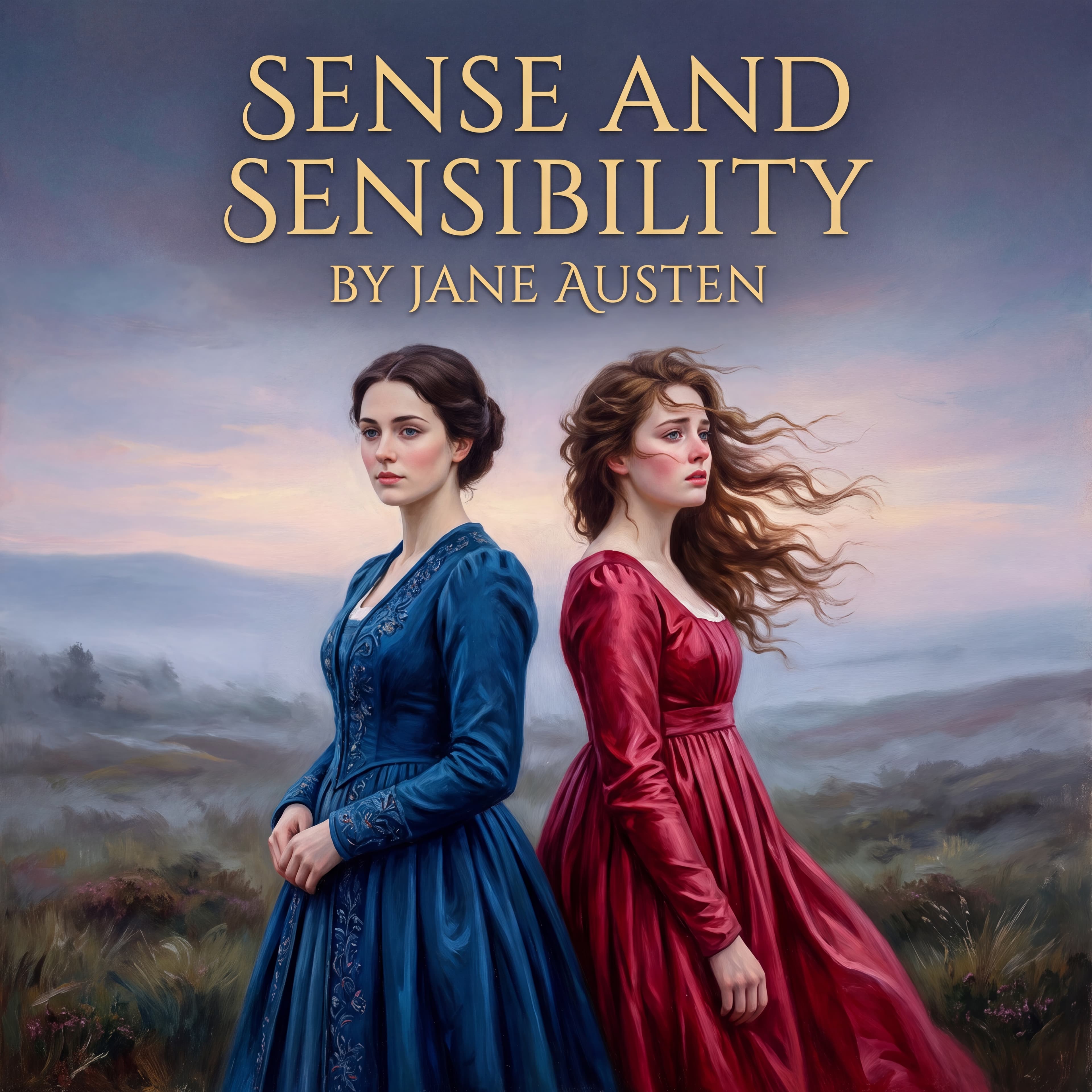
This is the complete novel, not an adaptation: all 61 chapters in order, from "It is a truth universally acknowledged" to the closing gratitude towards the Gardiners, who brought Elizabeth into Derbyshire, with opening and end credits. Only the 1894 edition's printed extras, such as its contents list and the captions to its illustrations, are left unread; none of them is Austen's. The production opens with Saintsbury's preface to that edition (26m 35s). He calls Austen's admirers "Austenians or Janites", says that he, for his part, declares for Pride and Prejudice "unhesitatingly", and closes by naming Elizabeth as the heroine he would choose to live with and to marry. The chapters run from 4m 05s (Chapter 12) to 29m 17s (Chapter 18). If you are coming to the book because Netflix's six-episode adaptation, with Emma Corrin as Elizabeth and Jack Lowden as Darcy, premieres on 3 December 2026, this is the whole novel in time for it. Its companions in our catalogue are Austen's Emma and Sense and Sensibility. Our romance production guide explains why a two-lead romance like this one benefits from a cast. Jane Austen died in 1817 and the novel is in the public domain everywhere, so the production is free to listen to in every territory.
By the numbers
- Format: Full-cast dramatized audiobook, unabridged
- Chapters: 64 (all 61 chapters of the novel, George Saintsbury's 1894 preface, and opening and end credits)
- Runtime: 12h 15m
- Cast: Elizabeth Bennet, Mr. Darcy, Mr. and Mrs. Bennet, Jane, Lydia, Mr. Bingley, Caroline Bingley, Mr. Collins, Charlotte Lucas, Lady Catherine de Bourgh, Mr. Wickham, Mr. and Mrs. Gardiner, and 30 speaking parts in all, including the narrator
- Production: AI character voices, original music, and sound effects
- Price: Free to listen
Ready to try it on your own book?
Start with 5,000words free →FAQ
Is this audiobook AI-narrated?
Yes. Every voice in Pride and Prejudice is AI-generated and produced by Midsummerr, with an original score and sound design. AI narration is disclosed as such on retail platforms that require it.
How long is the audiobook?
About 12h 15m across 64 chapters: Saintsbury's preface, the novel's 61 chapters, and opening and end credits. The chapters run from 4m 05s (Chapter 12) to 29m 17s (Chapter 18, the Netherfield ball).
Is this the full book or an adaptation?
The full book. The production follows the complete text of Pride and Prejudice in order, from the first chapter to the last, with a narrator and a separate voice for every speaking character. Only the 1894 edition's printed extras, such as its contents list and illustration captions, are left out.
Is this connected to the Netflix series?
No. It is Midsummerr's own production of Austen's novel and has no connection to Netflix's adaptation, which premieres on 3 December 2026.
Is Pride and Prejudice in the public domain?
Yes. It was published in 1813 and Jane Austen died in 1817, so the text is in the public domain worldwide. The full text is on Project Gutenberg.
Where can I listen?
Listen free at midsummerr.com/listen/pride-and-prejudice-jane-austen.