About this production
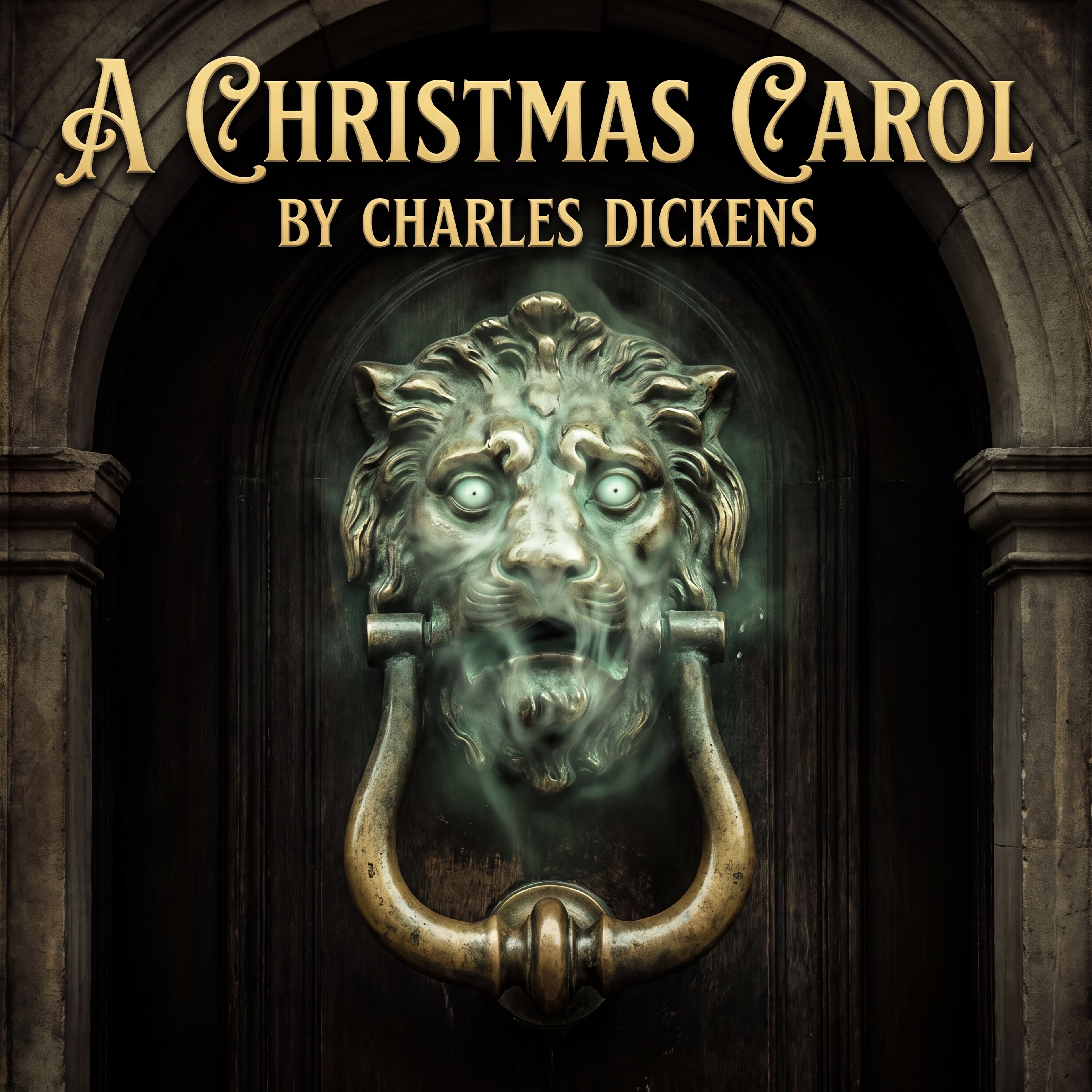
Chapman & Hall published A Christmas Carol on 19 December 1843, and Dickens built it to be heard as much as read. He divided it into five "staves", as if the book were a carol sung in verses, and opened it with a four-sentence preface calling it a "Ghostly little book". The structure is a series of visits: every stave puts Scrooge in a room with somebody, whether his clerk, his nephew, his dead partner, three spirits, his younger self or the woman he lost, and makes him listen. A story built from that many conversations needs a cast more than it needs a reader.
This production has 40 speaking parts: the narrator and 39 characters. Scrooge speaks in every stave and has 256 lines. His nephew Fred, who keeps inviting him to dinner, comes next with 44 lines across Staves 1, 3 and 5. Marley's Ghost has 42 lines, all of them in Marley's Ghost (Stave 1, 49m 03s). The Ghost of Christmas Past has 37 and the Ghost of Christmas Present 35, the same as Bob Cratchit. Scrooge himself gets three voices: a boy left alone at school, a young man at Fezziwig's ball, and the old man watching both. Then comes the long tail that a single narrator usually folds into one voice: Fan, who comes to bring her brother home; Belle, who gives him up in Stave 2; the two portly gentlemen collecting for the poor; the caroler at Scrooge's keyhole; Scrooge's niece and her plump sister at Fred's party; the businessmen trading gossip about a dead man; the charwoman, Mrs. Dilber and Old Joe haggling over his bed-curtains in Stave 4; Caroline and her husband; Peter, Martha and Belinda Cratchit; and the boy in the street who is sent running for the prize turkey. Tiny Tim has exactly one line, "God bless us every one!", because that is the only line Dickens gives him. The Ghost of Christmas Yet to Come never speaks in the book and has no voice here either. How many character voices an audiobook needs explains why parts this small still each get a voice of their own.
The score is built on three recurring themes. Scrooge's theme, a cold and solitary one, opens Stave 1 and comes back at the end of Stave 2 while he watches Belle's family by their fire. Marley's theme enters once Scrooge has fallen to his knees and cried "Mercy!" A third theme, for the grace of Christmas, is first heard when Fred argues with his uncle in the counting-house. It returns after the Cratchits' dinner in Stave 3 and again in Stave 5, when Scrooge goes to make amends with the gentleman he turned away. Fezziwig's ball gets a country dance that starts as the fiddler arrives, and the grocers' shops of Stave 3 get a festive street cue. A darker cue arrives with Ignorance and Want at the end of Stave 3, carries the silent spirit into Stave 4, and returns in the churchyard. The sound design stays with the text: every bell in Scrooge's house ringing at once, the cellar door that flies open with a booming sound, chains dragging up the stairs, the church clock striking the hours while Scrooge waits for each spirit, the extinguisher-cap he forces down over the first one, Tiny Tim's crutch, the storm around the lighthouse and the ship at sea, the iron gate of the churchyard, the phantom shrinking into a bedpost, and the church bells of Christmas morning when Scrooge throws up his window. Sound design in audiobooks covers how a score and effects like these sit under dialogue without crowding it.
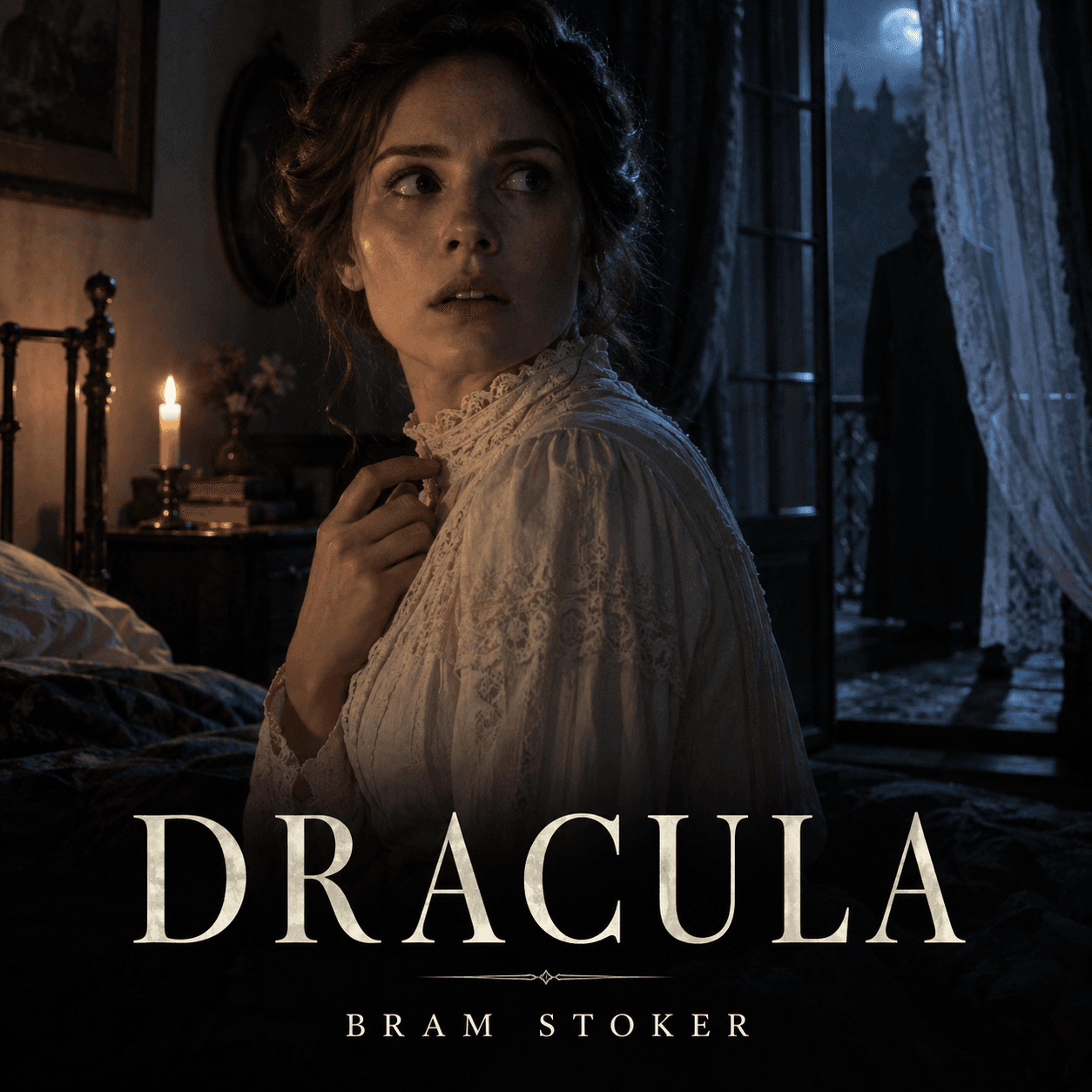
This is the complete text, not an adaptation: the preface and all five staves in order, from Marley's Ghost to The End of It, with opening and end credits. The staves run from 16m 44s (The End of It) to 59m 13s (The Second of the Three Spirits), so the book works as five evenings of listening in December. It is a ghost story first, and our horror and gothic production guide explains how dread is paced in audio. Its nearest companion in our catalogue is Dracula, another Victorian book about the dead coming back for the living. Charles Dickens died in 1870 and the 1843 text is in the public domain everywhere, so the production is free to listen to in every territory.
By the numbers
- Format: Full-cast dramatized audiobook, unabridged
- Chapters: 8 (Dickens's preface and all five staves, plus opening and end credits)
- Runtime: 3h 31m
- Cast: Ebenezer Scrooge, Marley's Ghost, Fred, Bob Cratchit, Mrs. Cratchit, Tiny Tim, the Ghosts of Christmas Past and Present, Belle, Fezziwig, Old Joe, the charwoman, and 40 speaking parts in all, including the narrator
- Production: AI character voices, original music, and sound effects
- Price: Free to listen
Ready to try it on your own book?
Start with 5,000words free →FAQ
Is this audiobook AI-narrated?
Yes. Every voice in A Christmas Carol is AI-generated and produced by Midsummerr, with an original score and sound design. AI narration is disclosed as such on retail platforms that require it.
How long is the audiobook?
About 3h 31m across 8 chapters: Dickens's short preface, the five staves, and opening and end credits. The staves run from 16m 44s (Stave 5) to 59m 13s (Stave 3).
Is this the full book or an adaptation?
The full book. The production follows the complete text of A Christmas Carol in order, from the preface to the last line of Stave 5, with a narrator and a separate voice for every speaking character.
Is it suitable for children?
For most families, yes. It is a ghost story: Marley and the last of the spirits are meant to frighten, and Stave 4 shows the Cratchits mourning Tiny Tim before the book turns to Christmas morning. Younger listeners may want a grown-up nearby for Staves 1 and 4.
Is A Christmas Carol in the public domain?
Yes. It was published in 1843 and Charles Dickens died in 1870, so the text is in the public domain worldwide. The full text is on Project Gutenberg.
Where can I listen?
Listen free at midsummerr.com/listen/christmas-carol-charles-dickens.