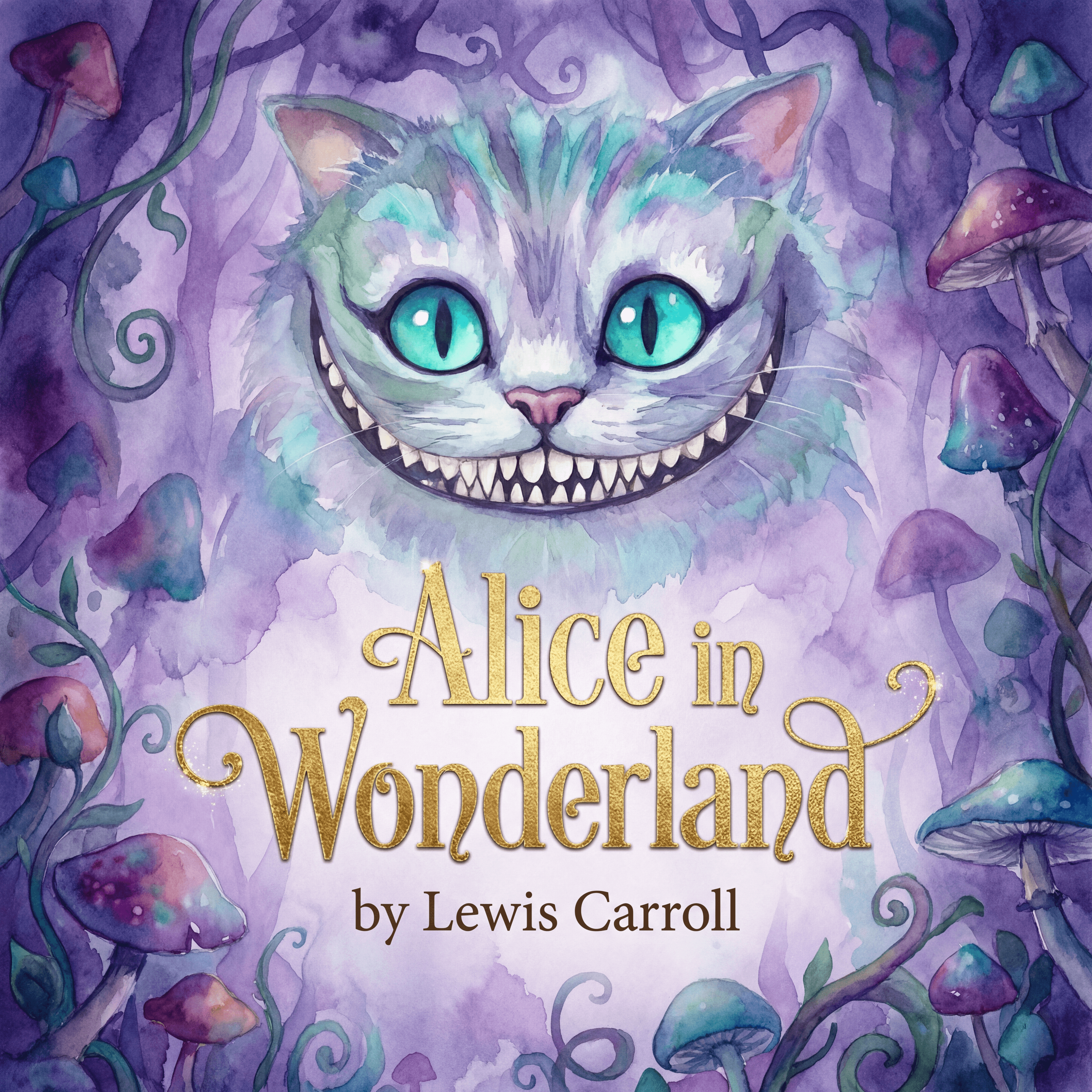
About this production
Alice's Adventures in Wonderland began as a story told aloud. On 4 July 1862 Charles Lutwidge Dodgson, an Oxford mathematics lecturer, rowed up the river towards Godstow with a colleague and the three eldest Liddell sisters and made up the tale as they went; Alice Liddell asked him to write it down. Macmillan published it in 1865 under the name Lewis Carroll, with illustrations by John Tenniel. It is a short book, about 26,000 words in twelve chapters, and almost all of it is talk: a girl, alone, arguing with one creature after another, each of whom is certain that she is the one being unreasonable. A book built that way needs a cast more than it needs a reader.
This production has 35 voices: the narrator and 34 characters. Alice is in every chapter and has 496 lines, and the narrator holds the rest of the book together around her. After Alice, the largest part belongs to the Mock Turtle, who appears in only two chapters and spends most of them weeping over his schooling and his song. The Mad Hatter, the March Hare and the Dormouse make one table in A Mad Tea-Party (Chapter 7, 17m 12s); the Duchess, her Cook and a baby that turns into a pig fill Pig and Pepper (Chapter 6, 17m 47s, the longest in the production); the Caterpillar asks "Who are you?" in Chapter 5 (14m 44s). The Queen of Hearts has fewer lines than the King, 45 to his 74, and nine of hers order an execution. Then there is the long tail that a single narrator usually folds into one voice: Bill the Lizard, who gets one line after being kicked out of a chimney; Pat, the Rabbit's servant; the Pigeon who takes Alice for a serpent; the Dodo, the Lory, the Duck and the Eaglet at the Caucus-race; an old Crab and her daughter, a Magpie and a Canary; the Frog-Footman and the Fish-Footman; the card gardeners Two, Five and Seven painting the roses red; the Knave of Hearts; and Alice's sister, who wakes her at the end. How many character voices an audiobook needs is about exactly this kind of book, where most parts are a handful of lines and each still has to sound like nobody else.
The score is built on three recurring themes: one for Alice's curiosity, one for the White Rabbit, always late, and a march for the Queen of Hearts. The Rabbit's theme arrives with his first "Oh dear! Oh dear! I shall be late!" in Chapter 1 (12m 01s) and follows him into the courtroom in Chapter 12 (16m 32s). The Queen's march is first heard in Pig and Pepper, before she has appeared, on the Duchess's "chop off her head!", and it returns when the procession of cards reaches the croquet ground in Chapter 8 (16m 13s) and again for "Sentence first—verdict afterwards" at the end of the trial. The Lobster Quadrille (Chapter 10, 17m 35s) gets its own dance air for the quadrille and a parlour waltz under "Beautiful Soup", which then fades into a distant reprise as the Gryphon hurries Alice away and the song follows them on the breeze. The sound design stays close to the text: the long fall in Chapter 1, the puppy, the shower of pebbles at the window and Bill scrabbling in the chimney of the Rabbit's house in Chapter 4 (15m 52s), the Caterpillar's hookah, the Pigeon's wings, the teapot, the milk-jug the March Hare upsets and the watch dunked in tea, and the White Rabbit's three blasts on the trumpet in Who Stole the Tarts? (Chapter 11, 16m 02s). The final paragraph, in which Alice's sister imagines her grown up and telling the story to children of her own, plays under a warm closing theme. Sound design in audiobooks covers how a score and effects like these sit under dialogue without crowding it.
This is the complete text, not an adaptation: every chapter, in order, from Down the Rabbit-Hole to Alice's Evidence, with opening and end credits. It is a natural first full-cast listen for a family, and our children's, middle grade and YA production guide explains why books for young listeners are cast and paced differently. Its nearest companions in our catalogue are The Fairy Caravan, another book of talking animals, and Anne of Green Gables, another girl who will not stop asking questions. Lewis Carroll died in 1898 and the 1865 text is in the public domain everywhere, so the production is free to listen to in every territory.
By the numbers
- Format: Full-cast dramatized audiobook, unabridged
- Chapters: 14 (all twelve chapters, plus opening and end credits)
- Runtime: 3h 2m
- Cast: Alice, the White Rabbit, the Mad Hatter, the March Hare, the Dormouse, the Cheshire Cat, the Caterpillar, the Duchess, the Queen and King of Hearts, the Gryphon, the Mock Turtle, and 35 voices in all, including the narrator
- Production: AI character voices, original music, and sound effects
- Price: Free to listen
Ready to try it on your own book?
Start with 5,000words free →FAQ
Is this audiobook AI-narrated?
Yes. Every voice in Alice in Wonderland is AI-generated and produced by Midsummerr, with an original score and sound design. AI narration is disclosed as such on retail platforms that require it.
How long is the audiobook?
About 3h 2m across 14 chapters: the book's twelve chapters, plus opening and end credits. The chapters run from 11m 31s (A Caucus-Race and a Long Tale) to 17m 47s (Pig and Pepper).
Is this the full book or an adaptation?
The full book. The production follows the complete text of Alice's Adventures in Wonderland in order, from Down the Rabbit-Hole to Alice's Evidence, with a narrator and a separate voice for every speaking character.
Is it suitable for children?
Yes. It is the original 1865 children's book, unabridged, and runs about three hours in chapters of 11 to 18 minutes, which suits a chapter a night.
Is Alice in Wonderland in the public domain?
Yes. It was published in 1865 and Lewis Carroll died in 1898, so the text is in the public domain worldwide. The full text is on Project Gutenberg.
Where can I listen?
Listen free at midsummerr.com/listen/alice-in-wonderland.