About this production
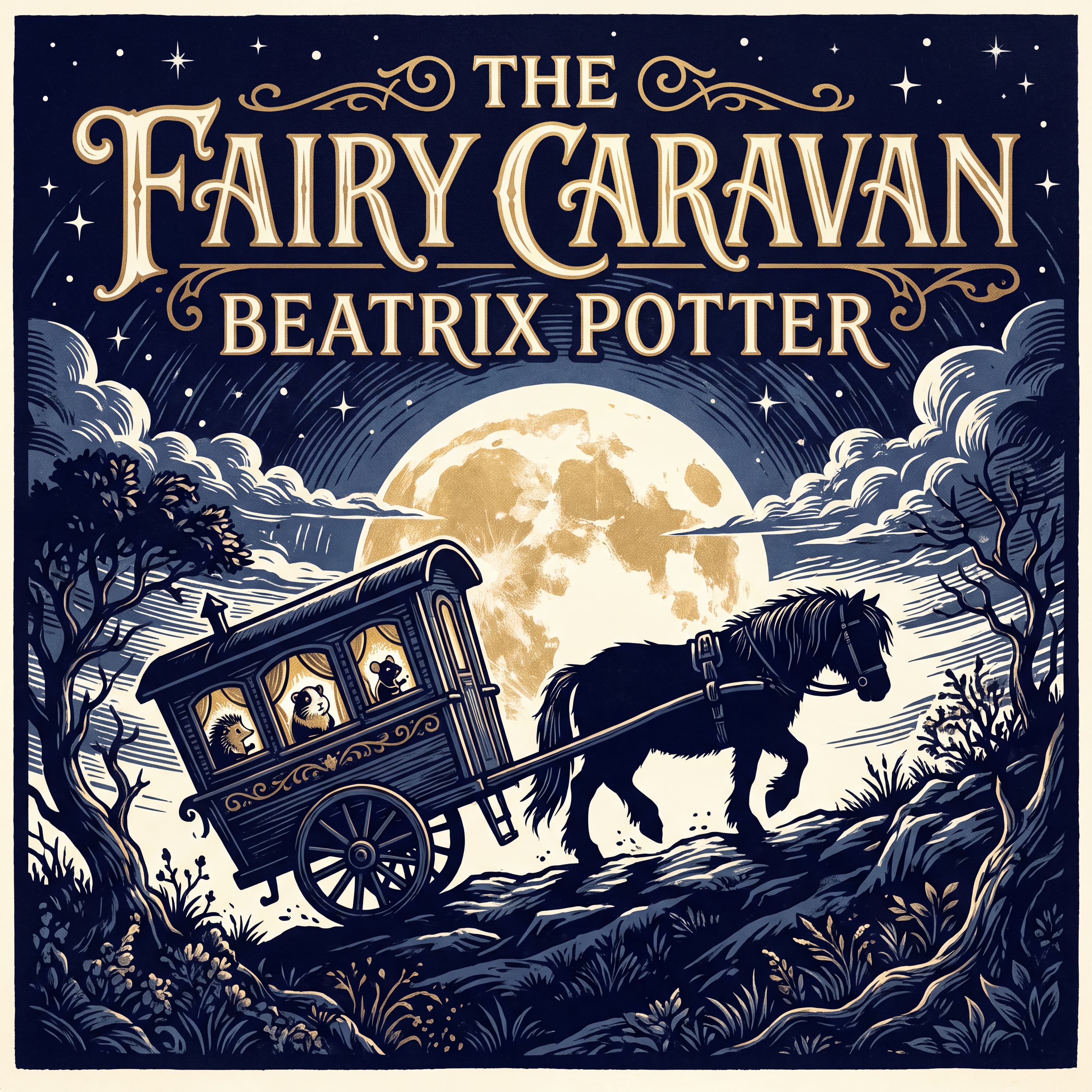
Tuppenny is a shabby, short-haired guinea pig in the town of Marmalade, where two rats trading as Messrs. Ratton and Scratch are selling a hair elixir at ten peppercorns the bottle. His neighbours, out of sympathy, try it on him. It works — and then will not stop working, until Mrs. Tuppenny is cutting and pulling at him daily and he bolts, falling in with a travelling circus the Big Folk cannot see, because every member carries fern seed in a pocket. The troupe is Pony Billy, Sandy the dog, Xarifa the dormouse, Paddy Pig, Jenny Ferret, Iky Shepster the starling and Charles the cockerel, and they move through country Beatrix Potter knew by name — Codlin Croft, Cuckoo Brow Lane, the fells and becks of the Lake District where she farmed.
This is not one of the small picture books. It is long, loose and episodic, and its real engine is that the animals tell each other stories: they make camp, and somebody takes a turn. In Chapter XI, Habbitrot the sheep tells the Border tale of the little grey woman spinning underground for a bride who would not spin for herself; the book ends on the life story of a north-country oak that was already standing in Queen Elizabeth's reign. A single narrator has to flatten all of that into one voice — the teller, the tale, and the listeners interrupting from the grass all arriving in the same register. A cast keeps the frame legible. You can hear who is speaking, who is being spoken to, and the moment a story-within-the-story opens up.
Potter herself never let England read it. She published it in 1929 through Alexander McKay in Philadelphia and refused a general English edition, calling the stories "too personal — too autobiographical"; to hold her copyright she had a hundred modified copies privately printed in Ambleside. A British edition did not appear until 1952, nine years after her death. In this Midsummerr production every character carries their own AI-generated voice, with an original score and sound design shifting under the camps, the fell weather and the tales. If you are weighing that treatment for a book of your own, our guide to whether your book needs a full cast covers when an ensemble earns its keep, when to score a scene and when to leave it alone covers the other half, and our children's and middle-grade production guide covers what changes when the listener is young. The Fairy Caravan is in the public domain, and this production is free to stream in full.
By the numbers
- Format: Full-cast dramatized audiobook
- Chapters: 23 chapter files covering the complete book, plus opening and end credits
- Runtime: 4h 2m
- Production: AI character voices, original music, and sound effects
- Price: Free to listen
Ready to try it on your own book?
Start with 5,000words free →FAQ
Is this audiobook AI-narrated?
Yes. Every voice in The Fairy Caravan is AI-generated and produced by Midsummerr, with an original score and sound design. AI narration is disclosed as such on retail platforms that require it.
How long is the audiobook?
About 4h 2m, running to the book's final chapter.
Is The Fairy Caravan like Peter Rabbit?
Not really. It is far longer than Potter's picture books, aimed at older children and adults, and built as a chain of linked episodes and stories the animals tell one another rather than a single short tale. Potter thought it too personal to publish in England at all, and it only appeared there in 1952.
Where can I listen?
Listen free at midsummerr.com/listen/fairy-caravan-beatrix-potter.