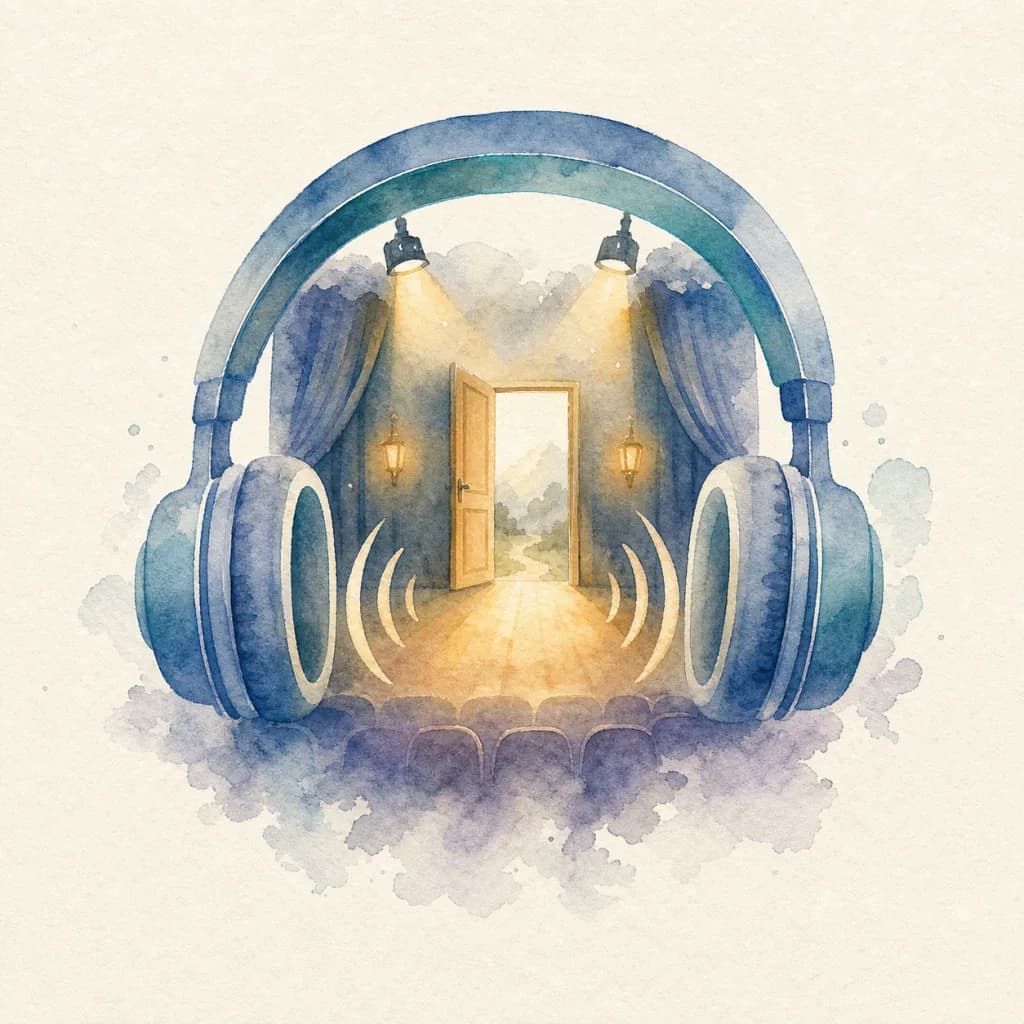
There's a moment, maybe ten minutes into a good dramatized audiobook, when you stop noticing that you're listening. The voice in your ear isn't a narrator anymore — it's a person in a room. The room has weather, and walls, and a door that opens behind them. You're not following the words. You're somewhere, watching it happen.
Most people have had this experience with film and television their whole lives, and almost never with audio. The default audiobook — one voice, no environment, accurate and flat — keeps you on the outside of the story the whole time. You're being read to. You're aware of being read to. The book is a thing happening near you, not to you.
A dramatized audiobook closes that gap. Full cast, score, environment — the same ingredients a film uses to make a screen disappear. GraphicAudio, one of the longest-running producers in the format, has marketed its productions for years under a single trademarked phrase: A Movie in Your Mind®. That's not a slogan dressed up as a product. It's an accurate description of what the medium does to your attention.
This piece is about that experience — what immersion actually feels like from the inside, and why dramatized audio is better understood as a cinematic entertainment medium than as a fancier kind of reading.
If you'd rather feel it than read about it: press play on a full production with headphones on, then come back.
What Immersion Actually Feels Like
Immersion is one of those words that gets used until it means nothing. So let's be concrete about what's happening in your head when a dramatized audiobook is working.
You stop tracking "who's reading"
The single biggest shift is one you don't consciously register. When one narrator voices every character, part of your attention is always quietly doing reconciliation work — that low voice was the villain a second ago, this one is the narrator, the bright one is the kid. You're matching voices to labels in real time. It's effortless enough that you don't notice it, but it's running, and it sits between you and the story.
Give every character a distinct voice and that whole process disappears. You're not deciding who's talking; you just know, the way you know in a conversation across a dinner table. The attention that was spent on tracking gets handed back to you, and it flows straight into the story instead. The performance stops being something you're aware of and becomes something you're inside.
The scene assembles itself
When the world arrives with its own atmosphere — a room tone, a distant storm, a score that tenses a half-second before the confrontation does — you don't have to construct the setting from description. It's already there, holding underneath the voices. Your imagination isn't building the stage from a blueprint; it's walking onto one that's already lit.
That's the felt difference between picturing a scene and being in one. Picturing is work. Presence is free. A dramatized production does the staging so your mind can spend itself on the part that matters — the characters, the tension, what happens next.
A flat narration tells you a story from across the room. A dramatized production seats you in the room, turns down the lights, and lets the room do the rest.
Time behaves differently
The clearest tell that immersion has kicked in is that you lose track of how long you've been listening. The thirty-minute commute that usually drags is suddenly over and you're annoyed, because you were in the middle of something. That's not a small UX nicety. That's the exact sensation a film or a binge-watched series gives you — the medium has taken over the foreground of your attention and is running the show. Flat audio rarely does this. Dramatized audio does it routinely.
Ready to try it on your own book?
Start with 5,000words free →Why It Earns the Name "Audio Movie"
Calling a dramatized audiobook "a movie in your mind" sounds like marketing until you line up what the two media are actually doing. They're using the same toolkit to produce the same effect: a constructed world that occupies your full attention and lets the real one fall away.
A film disappears the screen with cast, score, sound design, and spatial mix. A dramatized audiobook disappears the page with the same four things. The cast gives every character a body. The score tells you how to feel a beat before the dialogue confirms it. The environment tells you where you are without anyone announcing it. And increasingly, the spatial mix tells you where in the room a voice is standing.
That last one isn't hypothetical anymore. Premium dramatized productions now ship in Dolby Atmos and spatial audio for genuine three-dimensional presence — the full-cast Harry Potter editions rolling out through Audible are the most visible example, scored and mixed for height and depth, not just left-and-right. A footstep can cross behind you. A whisper can sit at your shoulder. The format has crossed from "voices and music" into "a place you can locate yourself inside."
The mechanics of how that score, those effects, and that mix are built and balanced are a craft in their own right — we break them down in how sound design transforms an audiobook. What matters here is the result: dramatized audio is doing the job a screen does, and it's doing it for the one slice of your day a screen can't reach.
The medium that competes for your eyes-free hours
Here's the cultural argument, said plainly. Every form of entertainment is fighting for the same finite pool of attention — and most of that fight happens in front of a screen. Film, TV, streaming, social, games: all of them need your eyes.
Audio is the only cinematic medium that works when your eyes are busy. The commute, the dishes, the run, the long drive, the can't-fall-asleep hour with the lights off — these are hours no screen can claim. For decades, audiobooks filled them with the flat, read-aloud version of a story because that's all the format offered. A dramatized audiobook fills them with something that competes with prestige TV for immersion, hands-free and eyes-free. It's not a substitute for reading. It's cinematic entertainment routed to the part of your life television was never going to reach.
That repositioning matters. A flat audiobook competes with podcasts and other audiobooks. A dramatized one competes with everything you'd otherwise watch — and it wins the hours nothing else can touch.
What This Asks of You as a Listener: Almost Nothing
The quiet luxury of an immersive production is how little it requires.
A flat narration track, for all its virtues, quietly puts you to work. You supply the emotional temperature. You hold the setting in your head. You track who's speaking. You mark the scene changes yourself when the narrator just keeps going. Most listeners do all of this happily — but it's labor, and on a long book it accumulates. It's part of why some people bounce off audiobooks entirely and assume they "can't follow audio." Often they can follow audio fine; they were just handed a version of the format that made them do the production in their own head.
A dramatized production lifts that load off you. The temperature is set by the score. The setting is held in the ambience. Who's speaking is obvious from the voice. The scene changes announce themselves. What's left for you is the part you actually came for: the story, the characters, the suspense of what happens next. Immersion isn't the listener trying harder. It's the listener finally getting to relax into the story because something else is carrying the staging.
There's a measurable shadow of this, too. Industry and platform reporting consistently associates immersive, full-cast productions with higher listener engagement and completion than flat single-narrator tracks — people finish what holds them. We're keeping this at the level of observation rather than dressing it up as settled science; if you want the deeper, brain-level account of why a richer production is easier to follow and remember, our companion piece on cognitive load and comprehension in audiobooks does that work. The short version for this piece is the felt one: lower effort in, more story out.
The Experience Is the Whole Argument
This is the part that doesn't survive being described, and it's worth being honest about that. You can read every word above and remain unconvinced, because immersion is not a claim — it's a sensation, and sensations don't transfer through prose.
So the real argument lives in your ears. The most useful thing you can do is run the comparison yourself: take a story you half-remember and listen to a dramatized production of it with the lights low and headphones on. Notice the moment the narrator stops being a narrator. Notice when you stop deciding who's talking. Notice when you check the time and too much of it has passed.
The format is having a moment for exactly this reason — it delivers an experience listeners didn't know audio could give them. We get into the market side of that surge, and where the format is heading commercially, in our look at why dramatized audiobooks are topping the charts. But you don't need the charts to settle the question. You need ten minutes and a good pair of headphones.
Midsummerr is built on the bet that this experience shouldn't be reserved for celebrity-budget productions. Full cast, original score, contextual sound effects, and a cohesive mix are what the Full Production tier is, at $5 per 1,000 words — the cinematic layer is the product, not an extra quoted on top of a narration fee. The four productions in our public listening library are the fastest way to feel what this post is gesturing at.
FAQ
What is a dramatized audiobook?
A dramatized audiobook gives every character a distinct voice and surrounds the performance with an original score and contextual sound effects, mixed into one cohesive world. Instead of one narrator reading all the parts, it plays more like a film or a radio drama — which is why the format is also called audio drama, radio play, or "graphic audio." For the format's full definition and history, see our full-cast audiobooks guide.
Why do dramatized audiobooks feel more immersive than regular ones?
Two reasons, both experiential. First, distinct voices remove the mental work of tracking who's speaking, so your attention flows into the story instead of into reconciliation. Second, the score and environment stage the scene for you, so you're in a place rather than picturing one from description. The combined effect is that you stop noticing the performance and lose track of time — the same way a good film makes the screen disappear.
Is a dramatized audiobook the same as an "audio movie"?
It's the closest audio gets. Producers like GraphicAudio have used "A Movie in Your Mind" for years, and premium productions now ship in Dolby Atmos and spatial audio for true three-dimensional presence. It uses the same toolkit a film does — cast, score, sound design, spatial mix — to occupy your full attention. The difference is it does it eyes-free, in the hours a screen can't reach.
Does the immersion really matter, or is it just a nice extra?
Beyond the felt experience, industry and platform reporting links immersive full-cast productions to higher engagement and completion than flat narration — listeners finish what holds them. We treat that as observation rather than proof; the deeper science of why richer audio is easier to follow lives in our cognitive load and comprehension piece.
Press Play and Judge for Yourself
No description settles this. Listening does. These are full dramatized productions on Midsummerr — put headphones on and give one the first ten minutes:
- Frankenstein — Gothic dread. Victor and the Creature in separate voices, storms and laboratories around them. Notice how fast the narrator stops sounding like a narrator.
- Jane Eyre — Period drama carried jointly by voice and score. A clear case of feeling the emotional temperature before the words spell it out.
- Alice in Wonderland — Whimsical and surreal, with the world shifting character to character. The setting assembles itself around you.
- Wuthering Heights — Brooding and restrained, the moors held low under the voices. Immersion through atmosphere, not volume.
If the experience lands — and it usually does within a chapter — that's the whole argument made. From there, see what every production includes and what it costs, or start your own and put a story you love through it.